


Networking
A network connects interfaces so applications can exchange data. A host may be a laptop, server, virtual machine or device.
Communication depends on a usable path, compatible protocols and endpoints that are ready to send and receive.

A switch connects devices within a local network; a router forwards IP packets between networks. A wireless access point connects radio clients to a LAN. Copper, fiber and radio carry signals. LAN describes a local network; WAN describes connectivity across a wider area. The internet interconnects many independently operated networks.
Bandwidth is link capacity; throughput is the achieved transfer rate. Latency is delay, often measured as round-trip time. Jitter is variation in delay, and loss means packets did not arrive. A 1 Gbit/s link has a theoretical 125 MB/s rate before overhead; a distant or congested path can deliver much less.
OSI and TCP/IP models
Layer models organize responsibilities and help locate failures. OSI has seven conceptual layers; the common TCP/IP model has four. Real protocols do not always fit one box neatly, but the models remain useful for learning and troubleshooting.

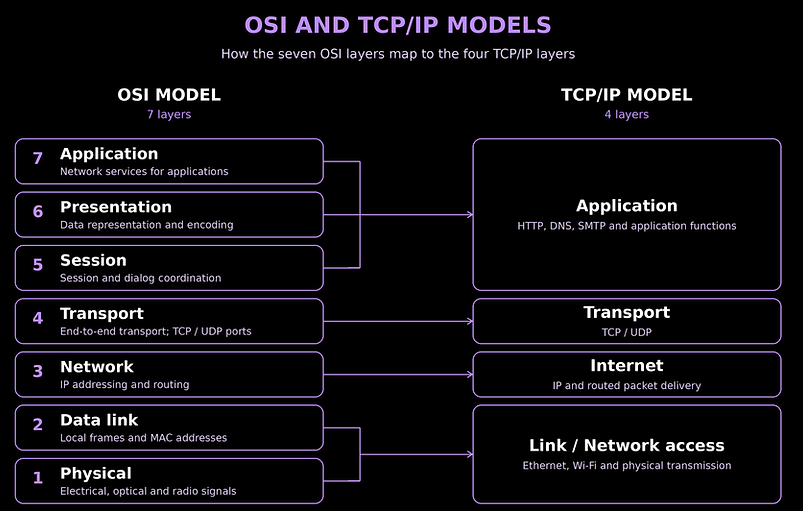

An IP packet carries source and destination IP addresses. On an Ethernet link, that packet travels inside a frame with source and destination MAC addresses. The local frame delivers the packet to its next hop, which may be the destination or a router.
IP addresses
An IP address identifies an interface in an IP network. A machine can have several interfaces and addresses. An IPv4 address contains 32 bits, written as four decimal octets. IPv6 contains 128 bits and uses hexadecimal notation.

Private IPv4 space can be reused by separate organizations and is not routed on the public internet.
Public addressing supports global reachability when routing and security allow it. An address outside the private ranges is not automatically a usable public address.

CIDR and subnet masks
CIDR writes an address range as a network prefix and a slash length, such as 192.168.10.0/24. The /24 says the first 24 bits are fixed. Eight host bits remain, giving 2^8 = 256 total addresses. A longer prefix describes a smaller range.


Subnetting: one /24 becomes two /25s
Start with 192.168.10.0/24. Borrowing one host bit creates two equally sized /25 blocks. Each
contains 128 addresses. Subnetting changes boundaries and capacity; it does not itself configure routing or security between the resulting networks.


TCP, UDP and ports
IP delivers packets to addresses. Transport protocols help applications exchange data at those addresses. A port is a transport-layer number identifying an endpoint used by a process. The same port number can have different meanings for TCP and UDP.
TCP provides a reliable, ordered byte stream with retransmission, flow control and congestion control. Connection setup commonly uses SYN, SYN-ACK and ACK. UDP carries datagrams without built-in delivery or ordering guarantees. Applications can add those features: QUIC uses UDP and provides reliable streams and secure transport.

VPCs, Regions & Availability Zones
Amazon Virtual Private Cloud provides a logically isolated virtual network in an AWS Region. A VPC can span that Region’s Availability Zones. Each subnet belongs to exactly one AZ. Resources connect through network interfaces and use the subnet’s routing and security configuration.

A VPC defines address space and networking settings. A subnet allocates a part of that space in one AZ. An elastic network interface, or ENI, has attributes such as IP addresses and security groups. EC2 instances use ENIs; many managed services also create interfaces in your subnets.
A default VPC is configured for convenient initial use, with default subnets and an internet gateway. A custom VPC gives you explicit control over addressing, subnet roles, routes and access. Resources do not become resilient merely because their VPC spans AZs: deploy suitable application capacity and data protection across failure domains.


